

A powerful explosion ripped through the crowded Red Fort area in central Delhi on Monday evening, killing at least eight people and injuring more than twenty others. The blast, which occurred around 6:50 PM, sent shockwaves across the Indian capital and reignited political and regional tensions, as Indian politicians swiftly pointed the blame toward Pakistan — even before investigations concluded.
According to Delhi Police officials, the explosion originated from a car that had stopped at a traffic signal near the Red Fort Metro Station. The vehicle detonated suddenly, setting ablaze nearby vehicles and causing panic in one of the most densely populated zones of the city. Eyewitnesses described scenes of chaos, with flames leaping into the air and smoke blanketing the area within seconds.
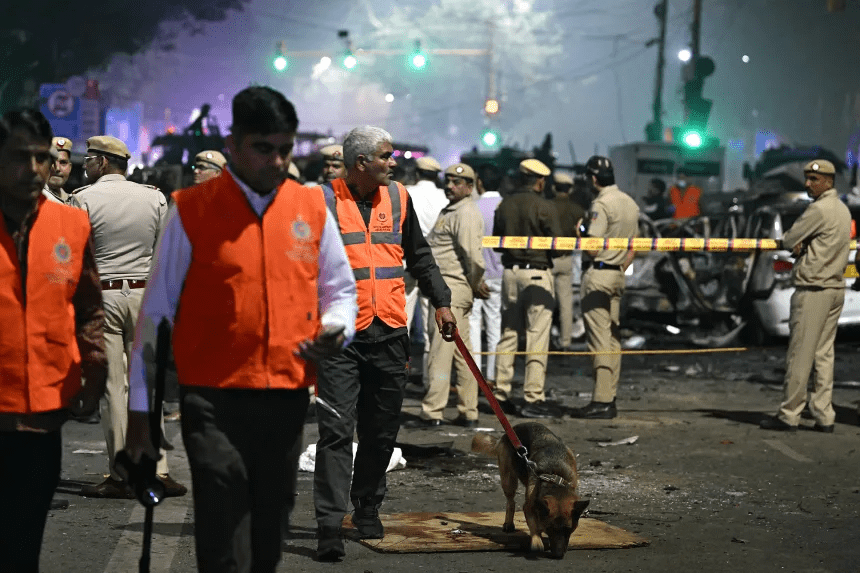
Emergency services rushed to the scene, while the area was cordoned off as bomb disposal squads and forensic experts began collecting evidence. The National Investigation Agency (NIA) joined the probe, citing the “possibility of a terror angle,” though no group has claimed responsibility so far.
Prime Minister Narendra Modi held an emergency meeting with senior officials, including Home Minister Amit Shah, to assess the situation. The government has ordered a comprehensive investigation and heightened security across all major urban centers.
Political blame game begins
Within hours of the incident, political reactions poured in — with leaders from the ruling Bharatiya Janata Party (BJP) and the opposition Aam Aadmi Party (AAP) offering sharply different takes.
AAP’s Rajya Sabha member Sanjay Singh went on record blaming Pakistan for orchestrating the attack, calling it “an assault on India’s pride and sovereignty.” He added, “Only Pakistan is capable of such cowardly acts. This was not just a blast — it was a symbolic strike on the heart of our heritage.”
However, security experts and opposition voices have urged restraint, cautioning against premature accusations before the completion of forensic analysis. Former intelligence officers have also emphasized that initial evidence does not conclusively suggest foreign involvement, and the cause might still turn out to be accidental — such as a fuel or cylinder explosion.
Rising regional tension
The accusations have already stirred unease in Islamabad. While Pakistan’s foreign ministry has yet to issue a formal statement, diplomatic sources indicated deep concern over what they described as “baseless and politically charged” rhetoric.
Observers believe the incident could strain already fragile Indo-Pak relations, especially if Indian authorities officially label the event as terrorism linked to cross-border networks.
Forensic investigation and next steps
Investigators are currently analyzing CCTV footage from nearby shops and traffic cameras, while vehicle registration records are being traced to identify the car owner. Preliminary reports suggest the car’s license plate may have been forged. Traces of ammonium nitrate and other explosive residues were reportedly found at the scene, though officials have declined to confirm details publicly.
Security agencies have also placed key Indian cities — including Mumbai, Lucknow, and Chandigarh — on high alert as a precaution. The NIA has formed multiple teams to explore whether the attack was part of a larger network or a standalone event.
If the investigation establishes a terror connection, the blast could become one of the most significant security incidents in India in recent years. It could also reignite political rhetoric that frames domestic security through a regional lens, with Pakistan once again cast as the perennial adversary.
On the other hand, if the probe finds no external involvement, the premature political blame may expose the deep divisions in Indian politics — where even national tragedies swiftly transform into partisan battlegrounds.
For now, Delhi remains tense but resilient. The historic Red Fort, an enduring symbol of India’s independence and identity, stands scarred yet defiant — its red sandstone walls bearing witness to another grim chapter in the capital’s turbulent history.