
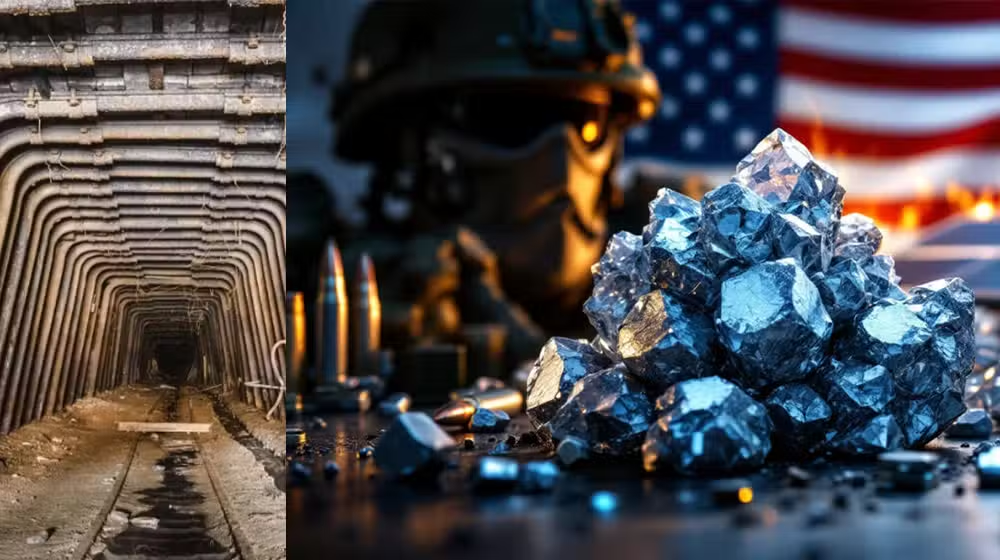


The United States is actively seeking to reduce reliance on China-dominated supply chains for strategic defense inputs particularly antimony, a critical material used in missile propellants, flame retardants, and battery systems. Recent reporting identifies Pakistan as an emergent alternative source for antimony, given China’s near-monopoly on processing and export markets.
Key supply-chain facts:
- Pakistan holds a modest share (~1%) of global antimony reserves, mostly extracted through small-scale mining.
- U.S. contractors and critical-minerals firms (e.g., Strategic Metals and others) are engaging with Pakistani miners and intermediaries to diversify sourcing and potentially establish export infrastructure directly to the U.S. market.
- Despite interest, Pakistan remains low on the value chain — antimony is largely exported raw, with minimal local refining capacity. China overwhelmingly dominates global processing capabilities.
Implication: The U.S. sees Pakistan as a supply-chain hedge against Chinese dominance for critical missile materials, not as an immediate replacement for industrial processing capacity. This aligns with broader U.S. defense industrial strategy to diversify global inputs and reduce single-source dependencies.
Bilateral Defence and Tech Dynamics: Beyond Minerals
The antimony interest exists within a broader context of shifting military and diplomatic relations between Washington and Islamabad:
1) Evolving U.S.–Pakistan Military Engagement
After years of tension, the U.S. has signaled renewed strategic engagement with Pakistan:
- High-level meetings between U.S. officials and Pakistan’s leadership have been reported, indicating a warming of bilateral ties.
- The Trump administration has notified Congress of substantial packages including modernisation aid for Pakistan’s F-16 fleet.
These shifts suggest the U.S. is potentially positioning military cooperation and critical-mineral access as part of a broader recalibration of relations in South Asia.
2) China’s Ongoing Role in Pakistani Defense Procurement
Despite these moves, China remains Pakistan’s principal defense supplier, providing a majority share of military imports and advanced systems such as missiles, aircraft, and other platforms.
Historical U.S. sanctions and controls have targeted Chinese firms supplying missile-applicable equipment to Pakistan — part of long-standing nonproliferation and export-control policy though these actions have reinforced Islamabad’s reliance on Beijing.
Geopolitical and Industrial Implications
Supply Chain Risk and Policy
- Diversification: U.S. policy is actively seeking to diversify strategic inputs like antimony by engaging emerging producers outside China, including Pakistan and other regional sources.
- Value Chain Limitations: Pakistan’s position as a raw producer — without significant refining capacity — limits its immediate ability to supplant China in advanced missile material supply.
- Industrial Strategic Risk: The scarcity of non-China antimony processing infrastructure highlights persistent vulnerabilities in global defense supply chains and underscores the need for investment in refining and certification outside China.
Regional Defense Balance
- U.S. engagement via aid and potential future defense contracts reflects a nuanced approach: building strategic ties without fully realigning Pakistan’s defense ecosystem away from China.
- Pakistan’s deep defense interdependence with China (over 80% of past arms imports) remains structurally significant.
The U.S. push for Pakistan as an alternative in missile supply chains is currently focused on critical mineral sourcing (antimony) as a strategic diversification from China’s dominant role. However, Pakistan’s limited industrial capacity and entrenched defense procurement relationship with China mean this is a long-term geopolitical and supply-chain play rather than an immediate replacement.
The broader trend reflects Washington’s hedging strategy: expanding ties with Islamabad for minerals and select military cooperation while maintaining export controls and sanctions where proliferation concerns exist.