
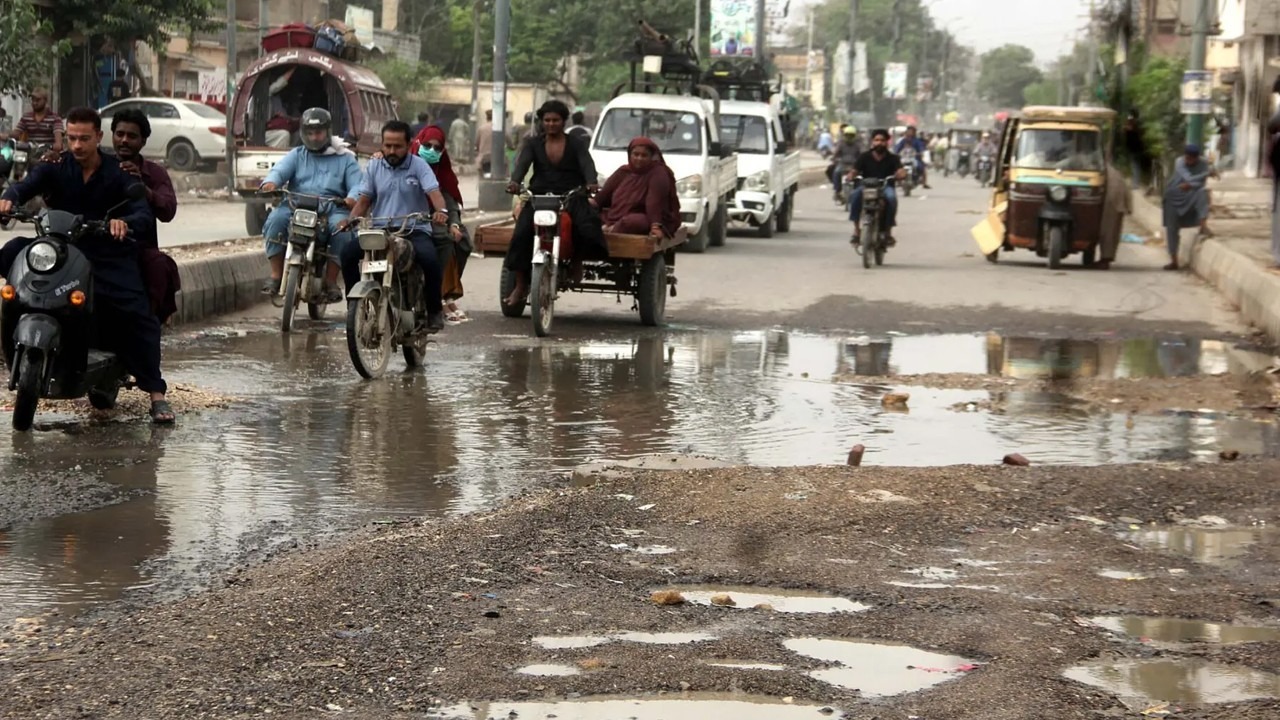


Karachi The biggest city in the nation and economic powerhouse of Pakistan is experiencing a worsening crisis that has an impact on public safety, everyday life, and urban viability. Once a prosperous port city supported by strong trade and economic activity, new data and professional analysis show systemic shortcomings in basic services, law enforcement, and infrastructure that jeopardize public trust and long-term development.
Urban Infrastructure in Decay
Karachi’s core infrastructure is in a precarious state due to a combination of unchecked population growth, persistent underinvestment, and administrative mismanagement. Roads, sewage networks, water supplies, and public transportation are examples of vital urban systems that struggle to operate efficiently even though they bring in a sizable amount of money for provincial and federal coffers. The provincial government was recently chastised by a significant business group for collecting infrastructure taxes but not using them to improve Karachi’s failing utility and road systems.
The ongoing problem of water supply has gotten worse, with extended outages reported in several areas; informal tanker operators have sharply increased prices in the face of service delivery gaps. As demonstrated by previous monsoon events, storm drainage systems are still insufficient, frequently turning seasonal rains into urban floods that disrupt traffic and endanger lives.
Additionally, residential safety has been jeopardized. Regulatory officials were suspended and a citywide audit of dangerous structures was conducted after a building collapse in Lyari earlier this year revealed shortcomings in construction oversight and enforcement of safety standards.
Governance and Planning Failures
Coherent long-term governance and political coordination are major problems, according to expert analysts and urban planners. Public services are lagging behind the demands of an expanding population because successive municipal and provincial administrations have failed to implement sustainable master plans.
Political infighting has also weakened accountability. Critics argue that partisan interests frequently override technical planning, delaying essential projects and fueling corruption. Polling indicates a large majority of residents believe political dysfunction has directly impeded Karachi’s development.
Public Safety, Crime, and Law Enforcement
Crime remains a serious everyday concern for Karachiites. Political leaders and civil society figures have repeatedly warned that street crime, including snatching and armed robbery, continues unabated, with enforcement agencies struggling to restore public confidence.
Beyond everyday crime, recent investigative reports suggest deep institutional problems within law enforcement. Allegations of police complicity with criminal networks in drug distribution and other illegal activities point to systemic corruption that undermines efforts to secure the city.
These security challenges coexist with broader socio‑economic pressures such as inflation driven by climate‑related crop losses, which have pushed costs of basic commodities upward in Karachi markets.
Human Impact and Public Sentiment
International assessments underscore Karachi’s deteriorating quality of life; a recent global livability index ranked it among the lowest‑performing cities worldwide. Residents routinely report everyday hardships: hazardous roads, intermittent utilities, and a sense of abandonment by civic authorities. Grassroots commentary often frames the crisis as a loss of civic autonomy and capacity to manage essential urban functions.
Paths Forward
Urban specialists emphasize that addressing Karachi’s crisis requires multi‑tiered reforms: strengthening local governance, injecting targeted investment into aging infrastructure, revamping public safety mechanisms, and enforcing transparent project execution. International comparisons suggest that resilient, well‑funded city administrations with clear accountability frameworks are better positioned to translate economic potential into reliable services and secure public spaces.
Without such structural changes, experts warn that Karachi’s descent into systemic distress will deepen, posing risks not only to its inhabitants but to Pakistan’s broader economic stability.