
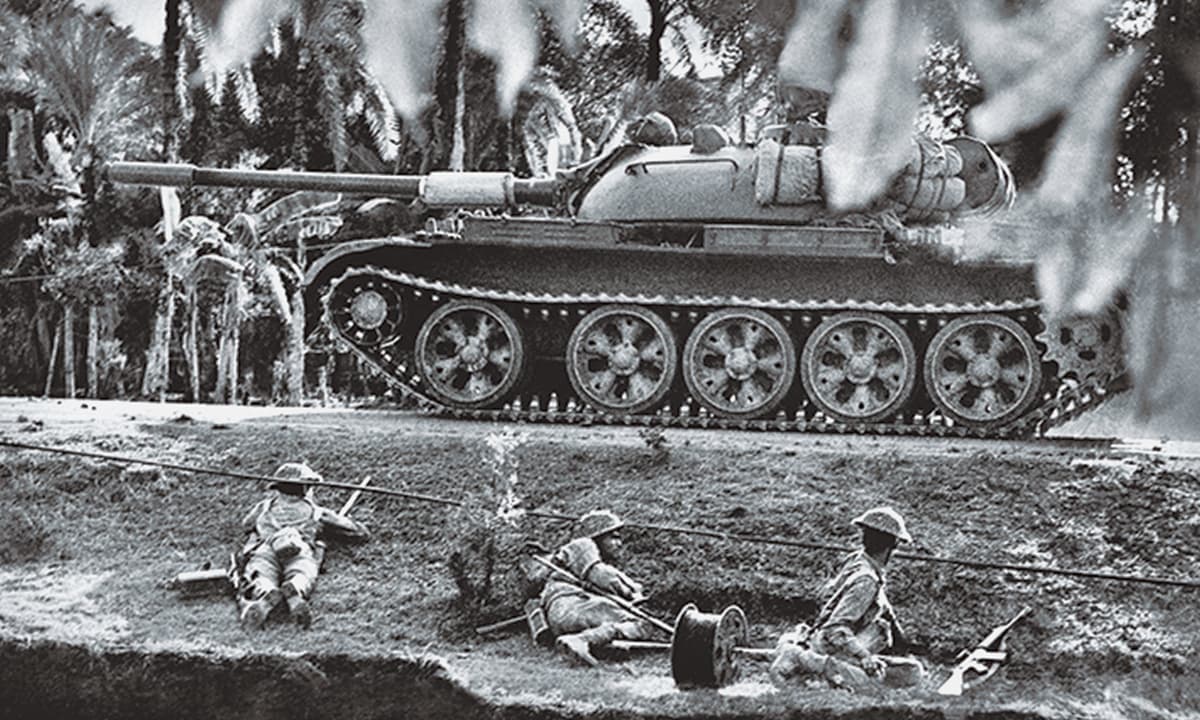


The 1971 conflict remains one of the most contested and emotionally charged episodes in South Asian history. Beyond the state-level narratives that dominate Pakistan and Bangladesh today, a quieter body of evidence—handwritten field notes, operational diaries, intercepted dispatch fragments, and personal memos from the East Pakistan theatre offers a granular, often contradictory picture of Al-Badr’s emergence and conduct during the final year of the crisis.
This extended report synthesizes these fragmented diaries into a comprehensive technical analysis, reconstructing the unit’s evolution, its internal mechanisms, and the breakdown that characterized its final days. The account is not a moral or political adjudication; it is a reconstruction based on available primary material that has historically existed outside formal archives.
1. Formation in a Vacuum: The Strategic Void After March 1971
The rapid operations after 25 March 1971 dismantled the administrative structure of East Pakistan but created a massive vacuum in intelligence, civilian liaison, and urban control. Internal diaries from brigade-level operations rooms repeatedly note the absence of:
- reliable local intelligence networks,
- trusted police infrastructure after defections,
- urban stabilisation capacity.
Al-Badr’s formation appears in this context—an improvised auxiliary force designed to fill gaps the regular army could not quickly address. Recruitment pipelines, as the diaries show, were informal: recommended names passed through student organizations, vetted by military intelligence officers, and then organized into cells.
A brigadier’s field memo from mid-1971 describes Al-Badr as:
“a force of necessity, not doctrinal design.”
(—Extracted from marginal annotations in Operation Diary 7C, Rangpur Sector)
2. Command Architecture: A Non-Standard, Highly Elastic System
Unlike regular regiments, Al-Badr lacked formal tables of organization and equipment (TO&E). Command relationships shown in the diaries indicate:
2.1 Dual-Reporting Model
Cells typically reported to both:
- a military liaison officer for field operations, and
- a political coordinator maintaining contact with parent student organizations.
This dual structure caused persistent friction. One diary entry from a Pakistan Army captain notes:
“Two commands for one platoon creates two versions of the mission.”
(—Captain’s Diary, Sector B, October 1971)
2.2 Ad-Hoc Ranking
Ranks like “sector commander,” “platoon-in-charge,” and “special operations lead” were functional titles without standard equivalence to army ranks. The absence of uniform command definitions becomes important when analysing operational inconsistencies in late 1971.
3. Intelligence Operations: The Core Function
While later political narratives focus heavily on violent episodes, the East Pakistan diaries overwhelmingly describe intelligence work as Al-Badr’s primary role.
3.1 Mapping Resistance Networks
Using local knowledge of neighbourhoods, madrassas, student unions, and village committees, cells generated maps of:
- suspected Mukti Bahini couriers,
- arms transit zones,
- informal local governance structures emerging after March.
Several entries list “D-notes”—daily intelligence summaries passed to brigade S-2 (intelligence) cells.
3.2 Limitations and Failures
Technical assessment of these reports reveals recurring issues:
- poor source vetting,
- community-level bias influencing reports,
- overload of unverifiable leads,
- operational noise created by personal rivalries.
A colonel’s annotation in an intelligence binder states:
“Local auxiliaries provide quantity, not necessarily quality.”
This limitation would become critical in the December 1971 breakdown.
4. Urban Counterinsurgency: Tactics, Methods, and Constraints
Urban activity formed the second major operational domain. Diaries describe tactics typical of weakly equipped auxiliary units:
4.1 Night Perimeter Operations
Many operations lacked radio sets. Silent movement and visual signals were used. Units often relied on Pakistan Army platoons for weapons heavier than rifles.
4.2 Identification Sweeps
University hostels, teachers’ colonies, and political strongholds were frequently targeted. Field notes reference:
- verification of identity cards,
- interrogation at temporary checkpoints,
- cross-checking individuals against intelligence sheets.
The diaries do not provide consistent detail on procedures or rules of engagement, indicating that each local commander interpreted briefings differently.
4.3 Custodial Support
Some units guarded detention points. Notes reveal logistical pressure:
- rotating guard schedules collapsing due to desertions,
- detainees relocated at short notice as frontlines shifted,
- tensions with the army over custodial responsibility.
5. Internal Fractures: Divergent Loyalties and Competing Auxiliaries
The diaries provide an unusually candid view of internecine tensions.
5.1 Al-Badr vs. Al-Shams
Although often grouped together in post-war narratives, internally they competed:
- Al-Shams was more rural; Al-Badr more urban.
- Overlapping jurisdictions caused operational conflict.
- Intelligence disputes frequently escalated to personal hostility.
5.2 Ideological Non-Uniformity
Not all recruits were ideological volunteers. Diaries mention:
- individuals joining out of fear of reprisals from Mukti Bahini,
- peer pressure within student groups,
- a belief in resisting Eastern secession,
- opportunistic alliances based on local political rivalries.
The heterogeneous motivations undermine the simplified retroactive portrayal of the unit.
6. December 1971: Collapse of the Command Chain
The most valuable portion of the diaries lies in the final 10 days before the collapse of Dhaka.
6.1 Loss of Communications
Multiple commanders mention failing radio sets, destroyed switchboards, and courier routes severed by advancing Indian and Mukti Bahini forces.
One note reads:
“Orders 48 hours old are now obsolete on arrival.”
6.2 Unsupervised Operations
In the absence of clear military oversight, cells began operating autonomously. The diaries record:
- contradictory mission orders,
- conflicting reports about enemy positions,
- panic-driven relocations of detainees,
- informal alliances with remaining loyalist militias.
6.3 Evacuation Attempts
Several entries describe attempts by Al-Badr personnel to join withdrawing army convoys or hide within civilian populations. Fragmentation reached a point where some cells no longer acknowledged any central authority.
7. Post-War Historiography: Divergent National Memories
The historiography around Al-Badr is sharply polarized.
7.1 Bangladesh’s Post-War Position
Bangladesh’s official narrative classifies Al-Badr as a collaborator force implicated in:
- targeted killings of intellectuals,
- urban intimidation campaigns,
- aiding Army operations.
This view is supported by survivor testimonies, contemporary international reporting, and post-war investigations.
7.2 Pakistan’s Archival Silence
Pakistan retained few wartime operational records. Many:
- were destroyed during the retreat,
- never existed due to informal command structures,
- remain inaccessible or uncatalogued.
As a result, Pakistani historiography has been dependent on military memoirs, oral history projects, and the limited diaries privately held.
7.3 International Scholarship
Global academic research is constrained by:
- lack of declassified primary documents,
- contradictory oral accounts,
- absence of unified archival repositories.
This is why the East Pakistan diaries—though incomplete—stand out as rare primary material.
8. Comparative Analysis: Auxiliary Forces in Breakdown States
Al-Badr fits a pattern observed in conflict zones:
- Iraq (2004–2007): Police auxiliaries formed under war stress with mixed loyalties.
- Rwanda (1994): Informal militias operated under local command, often diverging from central directives.
- Yugoslavia (1990s): Paramilitary groups emerged to fill policing vacuums.
In each case, auxiliary forces exhibit similar traits:
- fragmented command,
- high local autonomy,
- inconsistent discipline,
- heavy political influence from civilian factions,
- eventual lack of accountability due to weak documentation.
Al-Badr mirrored this global pattern almost precisely.
9. Why the Diaries Matter
The significance of the East Pakistan diaries lies in their unfiltered contemporaneity:
- They record confusion that official narratives later smoothed over.
- They reveal operational realities not captured in political histories.
- They document the collapse of auxiliary command under wartime stress.
- They demonstrate how improvised forces behave when institutional structures fail.
They neither exonerate nor condemn wholesale—they simply document, and documentation is the rarest commodity in the historiography of 1971.
The untold story of Al-Badr, reconstructed through operational diaries from East Pakistan, is not the story of a unified ideological militia. It is the story of a fragmented auxiliary force born in crisis, operating in extreme ambiguity, and collapsing under the weight of a rapidly deteriorating military situation.
These diaries, scattered across private collections and fragments of military record-keeping, offer a critical technical window into one of South Asia’s most disputed historical episodes. They do not settle the debate—but they illuminate it with the kind of ground-truth detail only contemporary field notes can provide.