
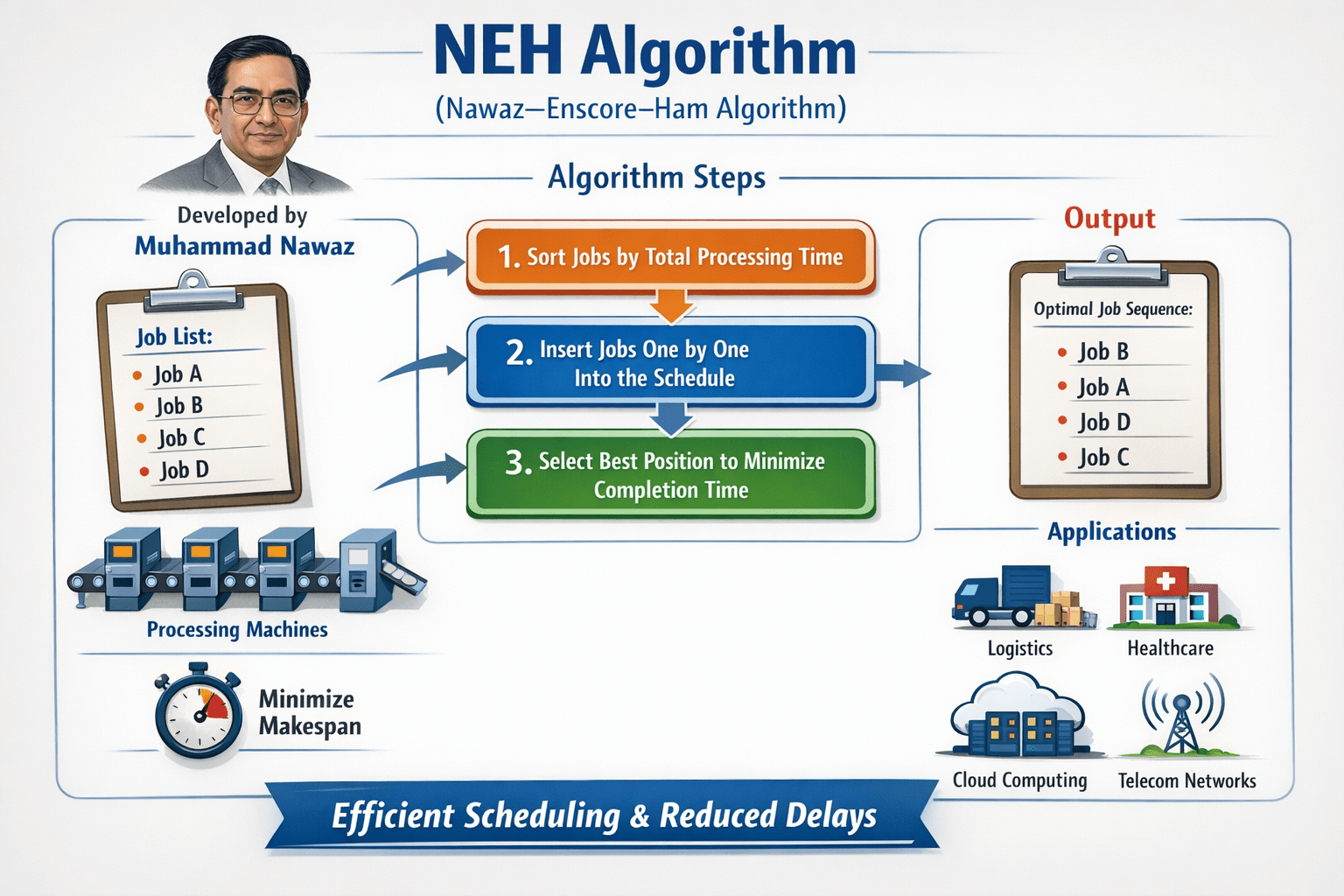


In 1983, a contribution by a Pakistani engineer quietly reshaped the way industries and researchers approach one of the most complex problems in operations research: efficient scheduling. That contribution, now globally known as the NEH (Nawaz–Enscore–Ham) algorithm, remains one of the most influential and widely cited heuristic methods in industrial planning and optimization.
The algorithm was co-developed by Muhammad Nawaz, an alumnus of the University of Engineering and Technology (UET) Lahore and Pennsylvania State University. At a time when computational resources were limited and exact optimization methods were often impractical for large-scale problems, Nawaz and his collaborators introduced a pragmatic, elegant solution to the flow shop scheduling problem—a class of problems central to manufacturing and production systems.
A Practical Solution to a Hard Problem
The NEH algorithm was designed to determine the most efficient sequence in which jobs should be processed across multiple machines. Instead of relying on exhaustive computation, it uses a constructive heuristic: jobs are first ranked based on total processing time and then incrementally inserted into the schedule at positions that minimize the overall completion time (makespan).
What set the NEH algorithm apart was not theoretical novelty alone, but usability. It delivered near-optimal results with minimal computational overhead, making it immediately attractive to real-world production environments. Its balance of simplicity, speed, and performance quickly turned it into a reference method in scheduling research.
From Factory Floors to Digital Systems
Over the decades, the relevance of the NEH algorithm has extended far beyond traditional manufacturing. Today, its principles are studied and adapted in:
- Logistics and supply chain optimization
- Healthcare operations and patient flow scheduling
- Cloud computing and task scheduling in distributed systems
- Telecommunications and network resource allocation
In academic literature, NEH is frequently used as a baseline or benchmark algorithm against which newer heuristics, metaheuristics, and AI-based scheduling approaches are evaluated. Its continued presence in peer-reviewed research underscores its robustness and enduring value.
A Lasting Place in Global Curricula
More than forty years after its introduction, the NEH algorithm remains:
- A standard topic in operations research and industrial engineering courses worldwide
- Actively used in production planning and scheduling environments
- One of the most cited heuristic methods in flow shop scheduling research
Its inclusion in textbooks and university curricula across continents reflects a rare level of longevity for an algorithm developed in the early era of applied computational optimization.
A Rare Distinction for Pakistan
Algorithms and formal scientific methods named after individuals are uncommon, particularly from developing countries. For Pakistan, the NEH algorithm represents a rare and lasting distinction: a globally recognized scientific contribution formally associated with a Pakistani engineer and embedded in international engineering and research literature.
Muhammad Nawaz’s work stands as a reminder that impactful innovation does not always arrive with headlines or large institutions behind it. Sometimes, it emerges through rigorous thinking, practical problem-solving, and an understanding of real-world constraints—qualities that continue to define the NEH algorithm’s relevance today.
As global industries increasingly rely on optimization to manage complexity and scale, the legacy of this 1983 contribution remains firmly intact, quietly shaping decisions in factories, data centers, and research labs around the world.