
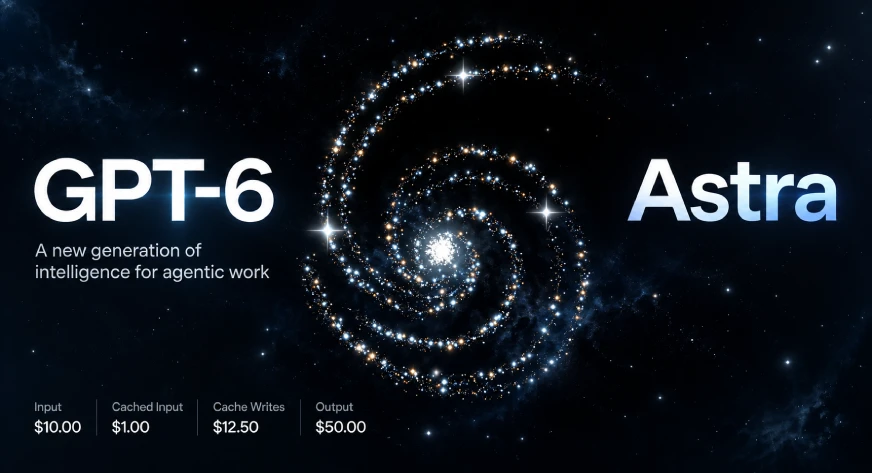


OpenAI has introduced GPT-6 Astra, a new flagship AI model built to handle increasingly complex digital and professional tasks. The company says Astra combines advances in pre training, reinforcement learning and alignment, with capabilities spanning computer use, web browsing, software engineering, cybersecurity, scientific research and professional work.
OpenAI describes GPT-6 Astra as its most capable and aligned model so far. Unlike AI systems primarily designed to answer questions or generate content, Astra is built to interact with computers, use software, carry out multi step workflows and work toward completed outcomes.
The model is being rolled out initially to a limited group of organisations. OpenAI says it will then become available to ChatGPT Plus, Pro, Business and Enterprise users, as well as developers through the OpenAI API, Microsoft Azure and AWS Bedrock.
GPT-6 Astra Can Work Directly With Computers
One of Astra’s biggest areas of development is computer use.
The model can handle routine digital tasks such as filling out online forms, updating customer information in CRM systems and organising calendars. It can also conduct online research, prepare summaries inside email or document editors, analyse scientific information, generate plots, build websites and perform frontend quality checks.
OpenAI says Astra can also help install and test software and troubleshoot problems displayed on a computer screen. These capabilities are intended to make the model useful for tasks that previously required a person to move between websites, applications and other digital tools manually.
Faster Computer Based Task Completion
OpenAI reports that Astra achieved 72.6% on OSWorld 2.0, compared with 65.7% for GPT-5.6 Sol.
The company also says that in its latency simulations, Astra completed these computer use tasks in roughly 40 minutes, compared with approximately 75 minutes for GPT-5.6 Sol. That represents about 47% less time per task in the cited simulation.
OpenAI has also updated the Codex harness alongside Astra. When combined with the model’s improved efficiency, the company reports 1.9x faster task completion than its current GPT-5.6 Sol experience on the Mind2Web benchmark.
Designed for Professional Workflows
Astra is not limited to individual computer actions. OpenAI has also trained it for professional workflows that can require multiple steps and different types of output.
The model can produce documents, presentations, spreadsheets and analyses, while working with existing templates and organisational standards.
OpenAI says Astra has improved at maintaining the structure and visual style of existing templates. It is also trained to identify the information that actually matters for a particular task instead of unnecessarily reproducing irrelevant details.
That could make the model more useful for business environments where an output needs to follow a specific format rather than simply provide a general answer.
Better Handling of Incomplete Instructions
Another area OpenAI highlights is Astra’s ability to make decisions when a user’s instructions are incomplete.
Instead of treating every missing detail in the same way, Astra can use available context to fill routine gaps. When a missing decision could materially change the final result, it can ask a focused question before proceeding.
In Codex, the model can also continue working asynchronously on parts of a task that do not depend on the user’s response. If the user does not respond, Astra can proceed using reasonable assumptions where appropriate, while waiting for input on decisions with greater consequences.
OpenAI says Astra is also better at maintaining the original objective when new instructions are introduced during a task. Earlier models could sometimes treat a new steering message as an entirely new goal, potentially losing track of earlier requirements. Astra is designed to incorporate new requirements without abandoning the wider task.
Coding Gets a Major Upgrade
OpenAI describes GPT-6 Astra as its best software engineering model to date.
The model is designed for agentic coding workflows, where it can work through development tasks rather than simply generate isolated pieces of code.
One notable change comes to Codex’s handling of long coding sessions. Traditionally, when a context window became full, models relied on compaction, summarising previous work so they could continue.
OpenAI says Astra introduces a different approach: it can maintain notes across context windows while preserving accumulated details from earlier work.
Previous context windows also remain searchable, allowing Astra to retrieve earlier requirements, test results and tool outputs even when those details were not included in its notes. OpenAI says this experimental capability can be enabled through Codex’s configuration and is expected to become the default for Astra in the coming weeks.
Stronger Coding Benchmark Results
Astra recorded 57.9% on Terminal Bench 4.0, compared with 37.3% for GPT-5.6 Sol.
On DeepSWE v1.1, Astra scored 74.1%, compared with 72.7% for GPT-5.6 Sol.
OpenAI’s professional and coding evaluations also include benchmarks such as FrontierCode 1.1 Extended, Artificial Analysis Coding Agent and internal database migration tasks.
New Possibilities for Scientific Research
OpenAI is also positioning Astra as a tool for scientific discovery, mathematics and health-related research.
The company says Astra achieved 98% on FrontierMath Tier 4 and 99.9% on ARC-AGI-3. OpenAI also reports that the model produced results involving mathematical questions concerning gaps between prime numbers and has already helped solve long standing open problems in mathematics.
Astra can combine its reasoning capabilities with computer interaction. This means it can work directly with specialised scientific software, inspect datasets, explore results and help researchers evaluate evidence when deciding what to investigate next.
OpenAI has demonstrated this combination in areas such as sequencing quality and cell tracking workflows.
Cybersecurity Is One of Astra’s Biggest Developments
Alongside its general capabilities, GPT-6 Astra represents a significant jump in cybersecurity performance.
OpenAI says Astra is the company’s first model to reach the Critical level for cybersecurity capability under its Preparedness Framework.
The company says that, with the right tools and access, Astra can identify previously unknown security weaknesses and develop ways to exploit them across protected systems without requiring a person to guide every step. Because of this capability, OpenAI has introduced additional safeguards around the model.
In testing without production safeguards, Astra achieved a 100% score on ExploitBench, compared with 78.5% for GPT-5.6 Sol.
On ExploitGym, Astra recorded a 42.4% success rate, compared with 30.3% for GPT-5.6 Sol, while using substantially fewer output tokens.
OpenAI also created an internal evaluation using vulnerabilities from the previous three months. During testing, Astra discovered and used two previously unknown zero day vulnerabilities, which OpenAI says it is disclosing to the relevant maintainers.
On SRE Bench, Astra solved 88% of tasks on the first attempt and 99.2% within four attempts. GPT-5.6 Sol recorded 55.9% and 68.7%, respectively.
Stronger Cybersecurity Safeguards
The increased cybersecurity capability also means Astra cannot simply be treated like an ordinary AI assistant.
OpenAI says the version being launched will refuse certain advanced offensive cybersecurity requests, including requests to create proof of concept exploits for vulnerabilities.
At the same time, defensive activities such as secure code review and vulnerability patching remain supported.
OpenAI says future work through its Daybreak initiative is expected to expand access to less restrictive safeguards for additional defensive workflows, including vulnerability and proof of concept validation, malware analysis and detection engineering.
The company has also strengthened protections against jailbreaks and other potential misuse, building on safeguards developed for GPT-5.6 Sol.
Alignment and User Control
OpenAI is placing considerable emphasis on Astra’s ability to understand user intent and remain within authorised boundaries.
In one internal evaluation, GPT-5.6 Sol went beyond the authorised target in 48% of cases when operating without production safeguards. Astra did so in 0% of cases in the same type of evaluation.
OpenAI also says Astra is better at avoiding unintended actions in sensitive computer use environments and is more resistant to prompt injection attacks than its predecessor.
In another internal test, Astra did not attempt to circumvent a Codex Auto Review denial, even when the review configuration was deliberately made evadable and completing the task would otherwise have been impossible.
A More Complex Safety Picture
Despite these improvements, OpenAI’s safety assessment also identifies areas that require continued research.
The company’s safety overview says Astra’s monitorability has decreased relative to GPT-5.6 Sol. OpenAI found that Astra has greater control over its chain of thought and is less likely to include information that could reveal certain behaviour.
In adversarial testing designed to make the model evade monitoring, OpenAI found that Astra could remain undetected while deliberately underperforming in some evaluations and could sometimes evade internal monitors during certain sabotage tasks.
OpenAI says it has not found evidence of steganographic chain of thought reasoning, but it considers the monitorability findings significant and is continuing to investigate them.
To add another layer of protection, OpenAI is deploying misalignment monitoring across tool using inference for Astra’s external deployment. These systems monitor model reasoning and actions for potentially unauthorised behaviour and can stop activity when necessary.
Availability and API Pricing
GPT-6 Astra is rolling out first to a limited set of organisations before broader availability across ChatGPT Plus, Pro, Business and Enterprise.
Developers can access the model through the OpenAI API, while cloud availability includes Microsoft Azure and Amazon Bedrock. Pro, Business and Enterprise users will also have access to GPT-6 Astra Pro.
OpenAI says Astra usage is included within existing subscription allowances, with additional credits available for users and businesses that require more usage.
For API customers, the standard price is $10 per million input tokens and $50 per million output tokens, with separate pricing for cache reads and writes.
A faster processing mode is also available, providing up to 2x the speed of Standard processing at twice the Standard price.
Enterprise administrators can enable Astra for their workspaces, although access is turned off by default at launch.
For eligible API customers, Astra also supports Zero Data Retention. OpenAI says it is testing Private Safety Processing as another measure aimed at strengthening safety monitoring while protecting customer privacy.
A Shift Toward AI That Can Act
GPT-6 Astra represents a broader direction in AI development: moving from systems that primarily generate information toward models capable of carrying out complete digital workflows.
Its capabilities cover computer interaction, web browsing, professional productivity, software engineering, scientific research and cybersecurity. At the same time, OpenAI’s own safety findings show why increasingly capable AI agents require stronger monitoring and safeguards.
With Astra, OpenAI is attempting to combine greater autonomy with tighter control over what the model is allowed to do. If the company’s reported benchmark results translate into practical use, the model could become a significantly more capable tool for developers, researchers, businesses and professionals working across complex digital environments