
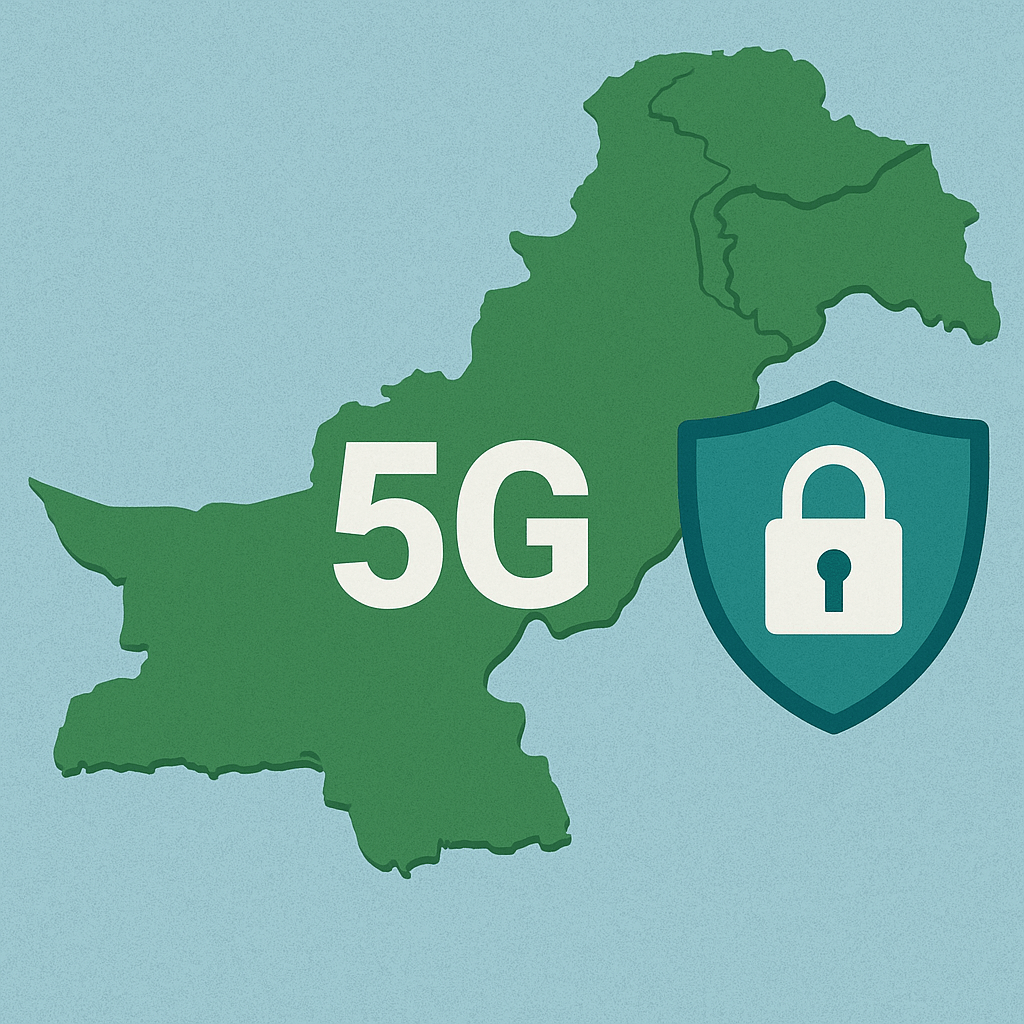


The Pakistan Telecommunication Authority (PTA) has released a comprehensive 5G security framework designed to harden the country’s next-generation mobile infrastructure against evolving cyber and physical threats. With commercial 5G rollout imminent, the new regulations mandate stringent technical, operational, and governance standards that align with global best practices while addressing local threat realities.
As Pakistan progresses toward nationwide 5G deployment expected early in 2026 after spectrum auctions these guidelines elevate security from a functional requirement to a cornerstone of national digital resilience.
Security by Design: Zero Trust and Encryption at the Core
At its core, the PTA’s strategy adopts a Zero Trust Architecture spanning all elements of 5G infrastructure, from radio access networks (RAN) to edge computing and cloud-hosted network functions. This model assumes no implicit trust, enforcing continuous verification, least privilege controls, and real-time monitoring.
Key protocol and cryptographic mandates include:
- Subscriber Identity Protection: Mandatory use of SUCI (Subscriber Concealed Identifier) to eliminate IMSI exposure and protect against identity tracking.
- Mutual Authentication & Encryption: Service-based architecture (SBA) core APIs must enforce mutual TLS (mTLS), OAuth 2.0 authorization, and modern encryption standards.
- Roaming Security: Strengthened inter-operator signalling via SEPP (Security Edge Protection Proxy) to counter spoofing and signalling manipulation.
- End-to-End Encryption: Adoption of TLS 1.3, AES, and ECDHE for data in transit across all network segments.
These controls pivot around internationally recognized standards such as 3GPP, GSMA security norms, ITU and NIST frameworks, ensuring compatibility with global operator ecosystems while imposing locally relevant safeguards.
Operational Security: Intelligence, Monitoring, and Segmentation
Beyond core protocols, the guidelines impose operational mandates that mirror enterprise-grade cybersecurity frameworks:
- AI-Driven Anomaly Detection: Real-time analysis for RAN and signalling anomalies to detect DDoS, spoofing, and lateral attacks.
- Network Slice Isolation: Logical partitioning with enforced quarantining and secure boundaries to protect multi-tenant environments.
- SOC & SIEM Integration: Operators must centralize logs and telemetry into Security Operations Centers equipped with SIEM for 24/7 threat visibility.
- Edge Hardening: Secure boot, firmware integrity checks, and TPM-based identity for edge and IoT devices.
This operational security focus reflects the expanded attack surface inherent in 5G’s virtualization, cloud-native components, and massive IoT deployments.
Physical & Governance Safeguards
Recognizing that cyber defense must integrate with physical and administrative controls, the guidelines include:
- Data Center Standards: Tier-3 certification, biometric access controls, and 24/7 surveillance at critical core infrastructure sites.
- Insider Threat Management: Strict role-based access control (RBAC), segregation of duties, and behavioural analytics for administrative accounts.
- Vendor & Third-Party Assurance: Regular security audits and uniform assurance requirements for multi-vendor environments.
By embedding governance and physical safeguards, the framework ensures that 5G services are resilient not just against remote attacks but also against misconfiguration and insider risk.
Strategic Implications for Pakistan’s Digital Ecosystem
Pakistan’s move places security at the same level of importance as performance and coverage in the 5G stack, responding to the projected proliferation of smart cities, autonomous systems, e-health platforms, and industrial automation that rely on ultra-reliable low-latency communication (URLLC).
Operators and vendors now face clear regulatory expectations, and compliance will likely become a standard requirement tied to licensing and spectrum assignment. Analysts frame the initiative as a preemptive strategy to prevent systemic risks that could compromise economic stability and public safety.
With Pakistan poised to operationalize 5G services imminently, the PTA’s security guidelines establish a rigorous baseline that aligns national infrastructure with international threat models and regulatory practices. By insisting on encryption, zero trust principles, continuous monitoring, and stringent governance, the authority is effectively reshaping the security posture of the telecommunications sector in preparation for a future where connectivity and critical services are inseparable